Odorous House Ant (Tapinoma sessile Say)
Description
Commonly infesting homes, buildings, and household food items, the odorous house ant is a widely distributed, native species found throughout North America. Learn how to prevent or manage an outbreak and explore the biology and behavior behind this persistent insect.
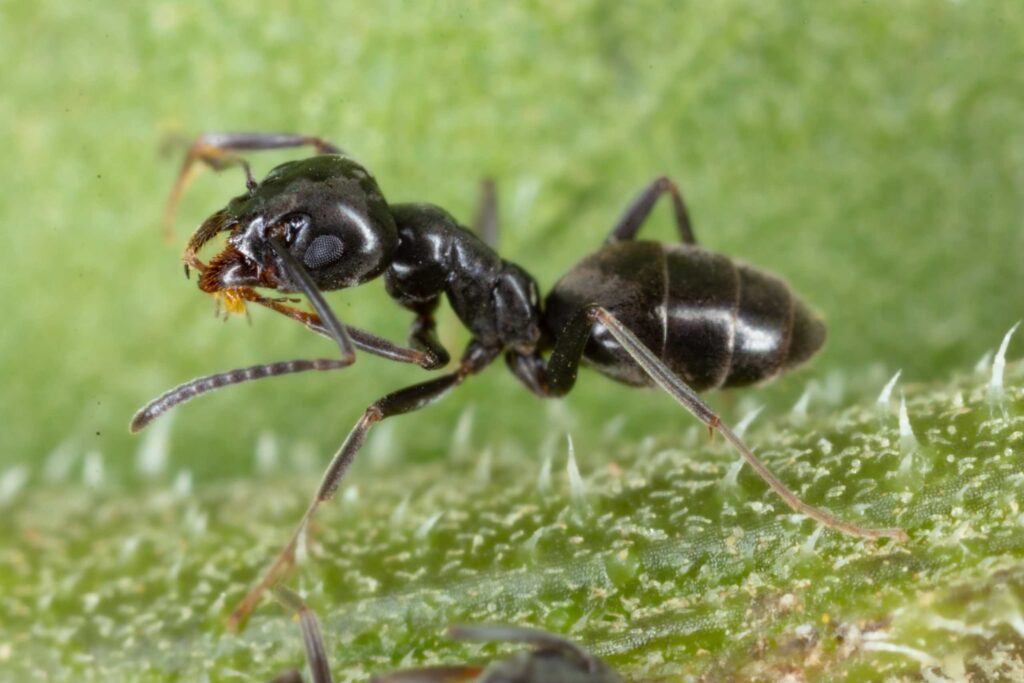
The odorous house ant, Tapinoma sessile (Say), is a temperate ant species that infests urban areas and shows invasive-like characteristics within its native range. It is named for the peculiar odor produced in the anal glands, which many describe as smelling of rotten coconut or blue cheese. Found throughout North America, odorous house ants (OHAs) have the widest geographic range and greatest ecological tolerance of any ant species within the region. While OHAs do not cause damage to structures, they are a very common, significant nuisance pest that can affect household food items and infest homes and buildings.
Identification
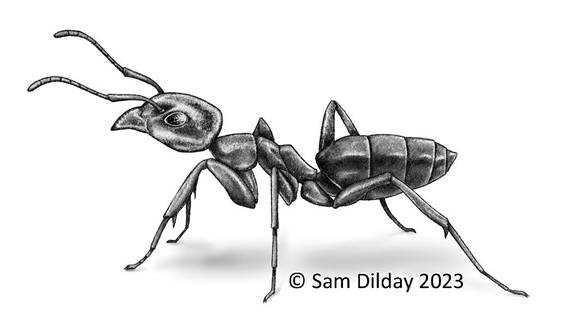
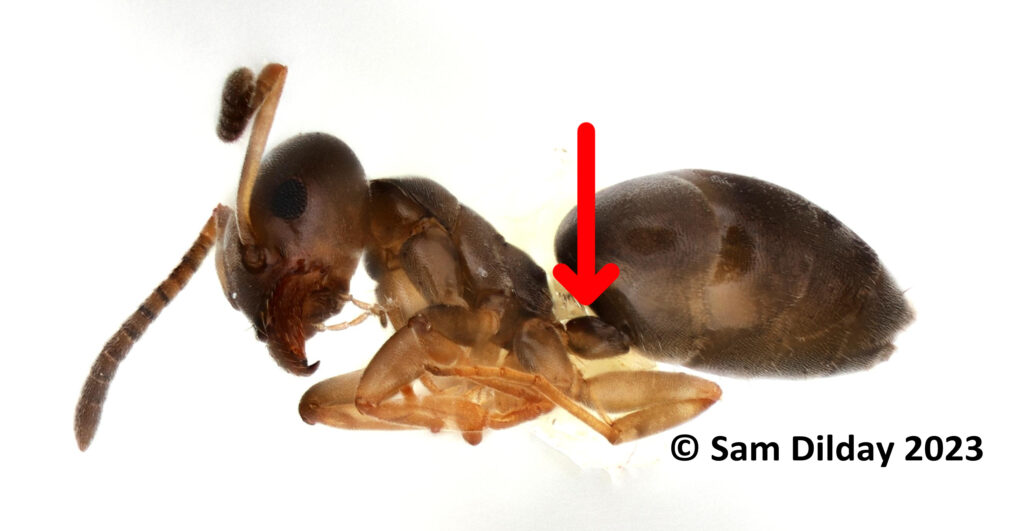
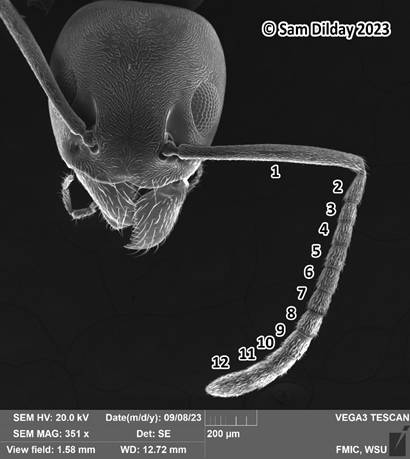
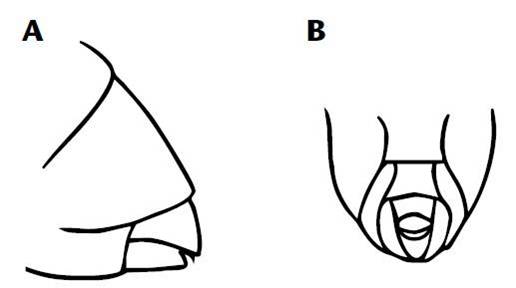
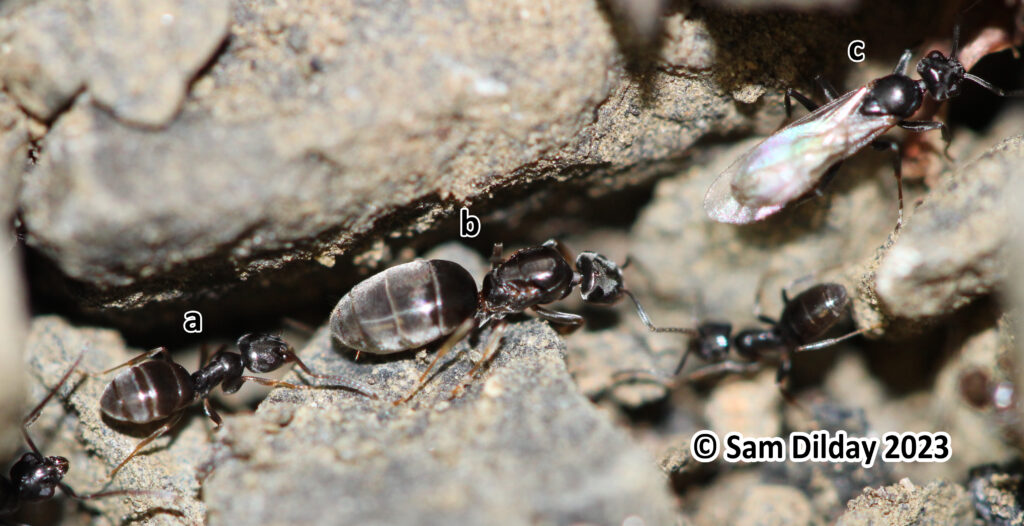
Workers of odorous house ants are monomorphic with a uniform size ranging from one-sixteenth to one-eighth inch and vary in color from brown to black (Figure 1). A unique characteristic of this species is the single, button-like node that is usually hidden from view under the abdomen (Figure 2). They differ from other ant species by the presence of a slit-like cloacal day without fringe hairs (Figure 3). The antennae have twelve segments without a club (enlargement) at the tip (Figure 4). Queens are larger than workers and have an enlarged abdomen (Figure 5). During spring and summer, winged-queens can be seen swarming. Reproductive males are also winged but are slimmer than queens (Figure 5).
Biology and Behavior
Odorous house ants are polydomous (multi-nests) and polygynous (multi-queens) within urban environments, while colonies in natural environments can be as small as a single queen and a couple hundred workers (Blumenfeld et al. 2022; Buczkowski et al. 2023). New colony formation can take place through swarming or by budding, the process of a queen leaving her established nest to create a new one and allowing her reproductive daughters to take on the original colony. This can lead to the development of super colonies made up of nonhostile, related workers cooperating with other colonies (Menke et al. 2010; Roulston et al. 2003; Buczkowski 2010; Janda 2022). OHA colonies can produce four to five generations per year. OHA workers undergo complete metamorphosis and take five to eleven weeks to develop from egg to worker but can take up to seven months, depending on exterior conditions. Within a few years of their numbers increasing, the colony will begin to produce winged males and virgin, winged females in their next reproductive event.
Wild colonies found in forests will nest under rocks, fallen trees, and rotting wood. In urban environments, OHA colonies have been known to nest in wall voids, concrete slabs, stacked wood and yard debris, and within stored food. Nests have even been found inside electronics and appliances. Nests are shallow and lack in permanency, traits associated with “tramp” species. Nests are known to move frequently (often within twenty-one days) based on weather, nesting substrate, and resources (Toennisson et al. 2020). Unlike other ant species that bring resources to the nest, OHAs move their brood to the food, which limits energy cost associated with resource transportation (Scholes and Suarez 2009). Unfortunately, this often leads to OHAs moving their colonies into unsealed food containers, resulting in food contamination.
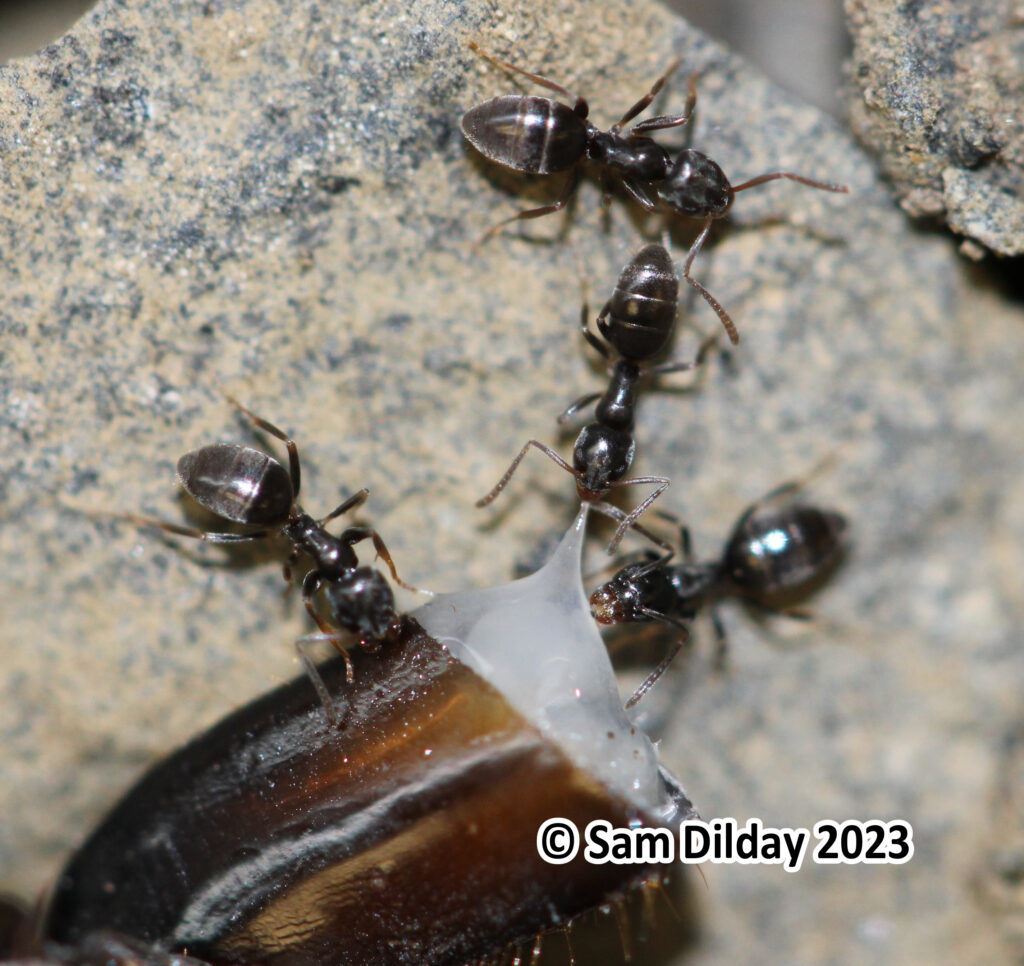
Known to forage day and night without any distinct peaks in activity, OHA workers follow well-established pheromone trails to resources and begin foraging as early as March. Foraging happens throughout the year in temperate regions, occurring between 42°F and 93°F (6°C–34°C) (Barbani 2003). It has been noted that workers tend to create and follow trails along a structural guideline, such as a wall or cabinet, which could explain OHA’s tendency to infest structures more readily (Klotz and Reid 1992). OHA colony trail distance ranges vary but are often between ten and forty-eight meters in length. The OHA is such a successful urban pest in part because they feed on a variety of materials (Buczkowski and Bennett 2006; Buczkowski and Bennett 2009). Foraging workers have been seen in the wild feeding on dead and living insects, dead animals, plant nectar, and honeydew (Figure 6). In urban settings, OHAs feed on pet food, dairy products, fruit juice, and pastries; their fondness for sugar led to the creation of another common name, sugar ants.
Impact and Pest Management
Once largely unremarkable, the OHA has become a predominant household pest in recent years. The factors contributing to this rise include their adaptability to urban environments, ability to form super-colonies, and tolerance to pesticides (Buczkowski and Bennett 2008; Buczkowski 2021; Brill and Buczkowski 2022). Household infestations are particularly troublesome, as colonies tend to “bud”—that is, after removal of one colony, another will move into the recently vacated space. This phenomenon increases the frequency of pest control visits and associated costs (Buczkowski and Kruchelnycky 2012).
In laboratory studies, OHAs are the hardest to kill with insecticides, as it took the longest time to reach 50% and 100% mortality compared to other ants. This low sensitivity to commonly used spray insecticides might explain why it is such a persistent pest (Scharf et al. 2004; Buczkowski 2021). When insecticides are sprayed widely, they often eliminate other, more vulnerable ant species, leaving OHAs behind (Salyer et al. 2014). Without competition and with easier access to nesting and food resources, OHAs can take over and spread into areas where other ants once thrived (Toennisson et al. 2011; Buczkowski 2024).
Avoiding OHA Problems
Keep a tidy, clean house and outdoor structure. Clean up kitchen food debris and do not leave food exposed. Be sure food sources inside houses or structures are kept clean and secured.
Clean up ants when found and use cleaning solutions to wipe down ant trails.
Keep vegetation away from the house outside along the perimeter of the house or structure.
Manage aphid problems on landscape outdoor plants and scale or aphid problems on indoor plants. OHA will feed on honeydew and can protect aphids from predation.
Management
Using preventative measures that limit access to the home can be a low-cost and effective method for dealing with OHA infestations. Sanitation is key to preventing trailing into the home. Kitchens and other areas of the home should be cleared of food debris, exposed stored food, and pet food. Countertops and appliances should be free of grease and other liquids that ants may feed upon. Taking steps to maintain cleanliness will help to discourage indoor foraging and trailing. If ants are seen in the home, clean any signs of trails with soapy water. Seal all potential entry points into the home, such as cracks in the foundation or around windows and doors.
Outdoors, remove materials that may be leaning or touching the building and foundation, such as stacked firewood, shrubs, and debris piles, as these are ideal nesting spots for OHAs. Odorous house ants are known to prefer to travel along edges and corners. Tree limbs and electrical wires are ideal for OHAs to travel along, and time should be taken to ensure branches and foliage are not touching the home (Klotz and Reid 1992; Klotz et al. 2000). Secondary pest problems can exacerbate an odorous house ant infestation. Worker ants have been seen tending to aphid and scaled insects for their honeydew (a sugar-rich secretion). Removing these secondary pests will limit resources to OHA colonies. Aromatic cedar mulch has been shown to repel OHAs and can be added to garden beds around the home (Meissner and Silverman 2001). Diatomaceous earth can also be spread in areas to deter OHA foraging, as the fine powder is abrasive against the exoskeleton and will absorb lipids from the outer, waxy layer, leading to fatal dehydration (Zeni et al. 2021). Care should be taken to follow the directions printed on the label to ensure proper usage.
Using Insecticides for Management
Some OHA infestations may require the use of pesticides. Bait stations designed for sugar-loving ants take time to work but can be used. Bait stations work by attracting ants to a food source containing slow-acting insecticide. This allows workers to bring the contaminated food to the nest to share with other workers and queens, eventually killing the whole colony. Baits can come in many forms, such as liquid, gel, and granules. Ants are generally liquid feeders; liquid and gel baits are easy to transport back to the nest. Granular baits contain some liquid which workers can consume before bringing the solid bait back to the nest. Larvae regurgitate digestive fluids to liquefy the solid bait, making it accessible for themselves and other ants to feed on. Set up baited stations that include an insecticide inside the house or structure where ants are active. Do this early in the season, beginning as early as February, when ants become active. Place baits in areas of high ant activity, but be sure to keep them out of reach from children and pets. Apply bait stations along the foundation of the structure to help reduce colonies immediately adjacent to the house or structure. Replace baits as needed to ensure enough insecticide reaches the colony. Depending on the severity of the infestation, it will take two or more weeks to see an impact on the population.
Pesticide sprays should be used only when necessary and applied according to the directions printed on the label. Find the nest, if possible, by following ant trails to the source. Once found, treat the nest with the appropriate pesticide. If the nest cannot be found, treat the area where the foundation and soil meet to form a chemical barrier. Examples of legal products to use in Washington State are listed below (Table 1). Some products are permitted solely for indoor use, while others are only allowed to be used outdoors—some may allow both. Be sure to choose a product accordingly. Always read and follow all label directions. Use the Pesticide Information Center OnLine (PICOL) to see all registered pesticides for Washington and Oregon.
Advanced infestations may need a pest management professional’s involvement. Recommended pest management companies can be found on the Washington State Pest Management Association (WSPMA) website. WSPMA is a nonprofit organization that represents pest management professionals in Washington State. The association’s mission is to provide education, training, and support to its members, while promoting the highest standards of professionalism and ethical conduct in the pest management industry. The Entomological Society of America’s Certified IPM Technician or Associate Certified Entomologist are other good sources for finding well-trained professionals. Whether a pest management professional is hired to remedy problems or not, an active combination of management strategies is needed to reduce and avoid infestations of OHA in households and buildings. With time, effort, and patience, even intense infestations can be reduced.
Table 1. Examples of legally allowed insecticide products for use in Washington State.| Control Products | Active Ingredient | EPA Reg. No. |
|---|---|---|
| Combat MAX Ant Killing Gel | Fipronil | 64240-42 |
| Combat Outdoor Ant Killing Granules | Hydramethylnon | 64240-25 |
| Bonide Termite & Carpenter Ant Killer Concentrate | Permethrin | 4-349 |
| Terro Ant Killer II Liquid Ant Baits | Sodium tetraborate decahydrate | 149-8 |
| Raid Max Double Control Ant Baits | Avermectin B1 | 4822-472 |
| Orthro Bug B Gon Insect Killer/Lawns and Gardens R-T-Spray | Bifenthrin, Zeta-cypermethrin | 279-9535-239 |
References
Barbani, L.E. 2003. Foraging Activity and Food Preferences of the Odorous House Ant (Tapinoma sessile Say) (Hymenoptera: Formicidae). Master’s thesis. Virginia Tech.
Blumenfeld, A.J., P.A. Eyer, A.M. Helms, G. Buczkowski, and E.L. Vargo. 2022. Consistent Signatures of Urban Adaptation in a Native, Urban Invader Ant Tapinoma sessile. Molecular Ecology 31(18): 4832–4850.
Brill, K., and G. Buczkowski. 2022. Regional and Caste-Specific Variation in Insecticide Susceptibility in Odorous House Ants, Tapinoma sessile (Hymenoptera, Formicidae). Journal of Applied Entomology 146(7): 895–902.
Buczkowski, G. 2010. Extreme Life History Plasticity and the Evolution of Invasive Characteristics in a Native Ant. Biological Invasions 12(9): 3343–3349.
Buczkowski, G. 2021. A Comparison of Insecticide Susceptibility Levels in 12 Species of Urban Pest Ants with Special Focus on the Odorous House Ant, Tapinoma sessile. Pest Management Science 77(6): 2948–2954.
Buczkowski, G. 2024. Insecticide Treatment of Invasive Ant Colonies Leads to Secondary Ant Invasions and Promotes the Spread of Invasive Ants. Biological Invasions 26(10): 3405–3415.
Buczkowski, G., and G.W. Bennett. 2006. Dispersed Central-Place Foraging in the Polydomous Odorous House Ant, Tapinoma sessile as Revealed by a Protein Marker. Insectes Sociaux 53(3): 282–290.
Buczkowski, G., and G. Bennett. 2008. Seasonal Polydomy in a Polygynous Supercolony of the Odorous House Ant, Tapinoma sessile. Ecological Entomology 33(6): 780–788.
Buczkowski, G., and G. Bennett. 2009. The Influence of Forager Number and Colony Size on Food Distribution in the Odorous House Ant, Tapinoma sessile. Insectes Sociaux 56(2): 185–192.
Buczkowski, G., and P. Kruchelnycky. 2012. The Odorous House Ant, Tapinoma sessile (Hymenoptera: Formicidae), as a New Temperate-Origin Invader. Myrmecological News 16: 61–66.
Buczkowski, G., S. Wang, and B.A. Craig. 2023. Behavioral Assays Reveal Mechanisms of Supercolony Formation in Odorous House Ants. Scientific Reports 13(1).
Janda, M. 2022. Becoming Urban: How City Life Shapes the Social Structure and Genetics of Ants. Molecular Ecology 31(18): 4589–4592.
Klotz, J.H., and B.L. Reid. 1992. The Use of Spatial Cues for Structural Guideline Orientation in Tapinoma sessile and Camponotus pennsylvanicus (Hymenoptera: Formicidae). Journal of Insect Behavior 5(1): 71–82.
Klotz, J., B. Reid, and J. Harnilton. 2000. Locomotory Efficiency in Ants Using Structural Guidelines (Hymenoptera: Formicidae). Sociobiology 35(1): 79–88.
Meissner, H.E., and J. Silverman. 2001. Effects of Aromatic Cedar Mulch on the Argentine Ant and the Odorous House Ant (Hymenoptera: Formicidae). Journal of Economic Entomology 94(6): 1526–1531.
Menke, S.B., W. Booth, R.R. Dunn, C. Schal, E.L. Vargo, and J. Silverman. 2010. Is It Easy to Be Urban? Convergent Success in Urban Habitats Among Lineages of a Widespread Native Ant. PLoS ONE 5(2).
Roulston, T.H., G. Buczkowski, and J. Silverman. 2003. Nestmate Discrimination in Ants: Effect of Bioassay on Aggressive Behavior. Insectes Sociaux 50(2): 151–159.
Salyer, A., G.W. Bennett, and G.A. Buczkowski. 2014. Odorous House Ants (Tapinoma sessile) as Back-Seat Drivers of Localized Ant Decline in Urban Habitats. PLoS ONE 9(12).
Scharf, M.E., C.R. Ratliff, and G.W. Bennett. 2004. Impacts of Residual Insecticide Barriers on Perimeter-Invading Ants, with Particular Reference to the Odorous House Ant, Tapinoma sessile. J. Econ. Entomol 97(2): 601–605.
Scholes, D.R., and A.V. Suarez. 2009. Speed-Versus-Accuracy Trade-Offs During Nest Relocation in Argentine Ants (Linepithema humile) and Odorous House Ants (Tapinoma sessile). Insectes Sociaux 56(4): 413–418.
Toennisson, A.T., W.E. Klingeman, and K.M. Vail. 2020. Odorous House Ant (Hymenoptera: Formicidae) Colony Movement in Response to Moisture, Shade, and Food Proximity. Environmental Entomology 49(6): 1263–1269.
Toennisson, T.A., N.J. Sanders, W.E. Klingeman, and K.M. Vail. 2011. Influences on the Structure of Suburban ant (Hymenoptera: Formicidae) Communities and the Abundance of Tapinoma sessile. Environmental Entomology 40(6): 1397–1404.
Zeni, V., G.V. Baliota, G. Benelli, A. Canale, and C.G. Athanassiou. 2021. Diatomaceous Earth for Arthropod Pest Control: Back to the Future. Molecules 26(24): 7487.
By
Sam Dilday, Graduate Student, Department of Entomology, Washington State University
Richard Zack, Professor, Department of Entomology, Washington State University
Todd Murray, Professor, Agriculture and Natural Resource Program Unit, Washington State University

EB1550E

Copyright © Washington State University
WSU Extension publications contain material written and produced for public distribution. Alternative text descriptions for select complex images were generated using ChatGPT (OpenAI), then reviewed and adapted to ensure compliance with Web Content Accessibility Guidelines (WCAG) accessibility standards.
Issued by Washington State University Extension and the US Department of Agriculture in furtherance of the Acts of May 8 and June 30, 1914. Extension programs and policies are consistent with federal and state laws and regulations on nondiscrimination regarding race, sex, religion, age, color, creed, and national or ethnic origin; physical, mental, or sensory disability; marital status or sexual orientation; and status as a Vietnam-era or disabled veteran. Evidence of noncompliance may be reported through your local WSU Extension office. Trade names have been used to simplify information; no endorsement is intended.